From Mismatched to Derailed: Where Does Philanthropy Stand?
PRE’s 2021 report Mismatched documented the gap between the rhetoric of 2020 and the insufficient resources that followed. Derailed draws on Candid’s data for 2019–2023 to assess how institutional philanthropy has responded since.
The landscape has shifted dramatically. The Supreme Court’s rollback of affirmative action, the lawsuit targeting the Fearless Fund, and sweeping efforts by the Trump administration to eliminate race-explicit strategies across universities, federal contractors, nonprofits, and foundations have deepened fear and confusion in the philanthropic sector. These developments have contributed to a chilling effect and accelerated a retreat from racial justice commitments.
Behind the numbers lies a deeper story: one of funders overhyping their commitment to racial justice in 2020 and then retreating all too quickly and quietly in the face of unprecedented attacks on equity, democracy, and philanthropic freedom.
The Five Ways Philanthropy Has Gotten Derailed from Its Progress on Funding for Communities of Color and Racial Justice
Too many funders are retreating from funding with a racial lens, reversing a decade of progress on funding for communities of color and racial justice and jeopardizing a fragile ecosystem at a time when the needs are more urgent than ever.
Attacks on human rights and civil society have pushed many in philanthropy toward fearful risk aversion, exacerbating the burden placed on movement leaders and shrinking crucial resources for building multiracial coalitions.
Funding continues to have a disproportionate focus on mainstream efforts such as education and services rather than racial justice, grassroots movement building, and structural change.
Some funders have taken the wrong lessons from the past two years, blaming losses on identity politics and vulnerable communities rather than the failure to fund racial justice coalitions at scale and for the long term.
Funders’ vacillation between exaggerating and obfuscating their support for communities of color has undermined efforts for transparency, accountability, and honest assessment of progress in funding racial justice.
This report reveals a decade-long setback in funding for communities of color — and yet much of the debate is driven by narratives that are simply disconnected from the facts. A sustained campaign from the Right has worked to punish racial equity efforts, while other critics have misread the moment as one of ‘overreach’ in funding communities of color and racial justice work.
The data show declining investment, not excess. If philanthropy continues to make decisions shaped by fear or misinterpretation rather than by what communities are facing, it will weaken the very infrastructure needed to resist mounting authoritarian threats.
The data show that funding for racial justice has followed a harmful, but unfortunately typical trend in philanthropy: a short-lived, insufficient ballooning of funding followed by a precipitous crash. Funders are pulling back from racial justice at a time when our communities need it most.
FUNDING FOR COMMUNITIES OF COLOR HAS FALLEN BACK A DECADE
Key findings from Derailed include:
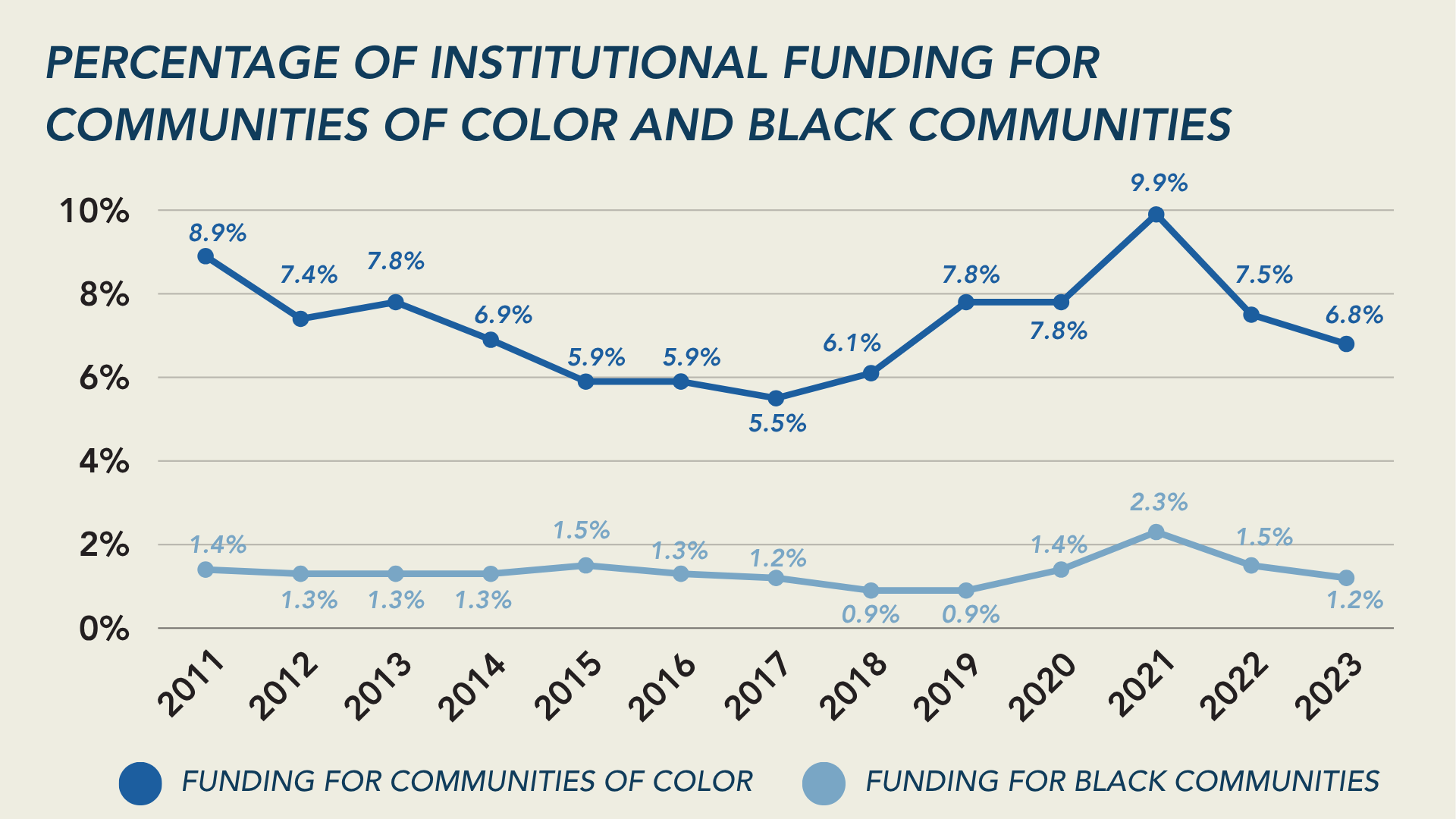
Overall institutional giving grew 44% between 2019 and 2023, but the share devoted to communities of color shrank.
Even at its 2021 peak, funding for communities of color represented less than 10% of all institutional giving.
By 2023, that share had fallen to 6.8% — lower than in 2014.
Funding for racial justice — defined as systemic change and power-building — never exceeded 1.4% of institutional giving.
Adjusted for inflation, support for communities of color fell 22.2% from 2021 to 2023.
Racial justice funding peaked at just $1.65 billion, roughly equivalent to the annual budget of a single mid-sized private university, which underscores the mismatch between need and philanthropic response.
Funding specifically focused on Black communities peaked at 2.3% of institutional funding in 2021, then fell to 1.2% in 2023—below the levels of the early 2010s and far lower than the 14.4% that Black communities compose of the U.S. population.
Citation: Derailed: Rising Attacks and Retreating Resources for Racial Justice. Philanthropic Initiative for Racial Equity. 2025.
Citation: Derailed: Rising Attacks and Retreating Resources for Racial Justice. Philanthropic Initiative for Racial Equity. 2025.
Completing the Picture with Key Perspectives from Movement Leaders
“Funding for racial justice has always been too low, and now it’s moving in the wrong direction at the very moment communities are under the greatest pressure. Foundations cannot meet this moment with a five-percent payout and cautious commitments. Defending democracy requires investing in the communities who are defending it. If not now, when?” — Glenn Harris, Race Forward and PRE Board Member
“If we are serious about combating the anti-Blackness at the core of our society, we must fund the fight for the long term so that it can be at scale with the problem it is trying to solve.” — charles long, Movement for Black Lives, author Views from the Field: Advancing Black Movement Power In a Time of Philanthropic Flux.
“Leaders described living with active and ongoing trauma, even as they continue to organize in their communities to defend democracy and to protect families from being detained or disappeared.” — Kenia Morales and Becca Guerra Molo, authors of Views from the Field: A Crossroads for Latinx Movements.
“The chilling effect in philanthropy didn’t land evenly. Black groups felt it first and most sharply. Funding shifted from ‘What do you need to win?’ to ‘What language will make lawyers comfortable?’ That’s not a strategy — that’s a slow-rolling abandonment. And it undermines the very people most targeted by authoritarian policy.” — Cliff Albright, Black Voters Matter Fund
“You heard some [funders] saying, ‘We’re committed to supporting racial justice but not to Palestine.’ There’s this refusal to recognize how integral this fight is to our racial justice and racial equity fights domestically.” — Darakshan Raja, Muslims for Just Futures
Citation: Derailed: Rising Attacks and Retreating Resources for Racial Justice. Philanthropic Initiative for Racial Equity. 2025.
Funding for mainstream education and service organizations captured the largest share of dollars. The top recipients of funding for communities of color continue to be dominated by charter schools, scholarship funds, and educational enrichment programs.
Funding for grassroots organizing in communities of color is even smaller, never exceeding $900 million in a single year. In 2023, funding for grassroots organizing for racial justice fell back down to $500 million, about one-third of one percent of all institutional funding.
In 2020, 382 descriptions of grants and pledges included the term “racial justice,” amounting to $926 million. In contrast, in 2023 303 descriptions of grants and pledges used “racial justice,” amounting to $86.29 million, a 90 percent drop in the total amount purported to have this focus.
Recommendations to Get on Track PRE emphasizes that “derailed” does not mean irreversible. The report argues that philanthropy can still get back on track if leaders confront the realities in the data, reject political pressure that distorts decision-making, and recommit to sustained, race-explicit investment in the communities most under attack.
Recognize and Affirm the Importance of Maintaining Race-Explicit Funding Strategies. Philanthropy must not retreat or over-comply in the face of political pressure or legal threats. Foundations are uniquely situated to defend and sustain race-explicit strategies, which are essential tools for fighting the realities of racial inequality.
Go Beyond Equity to Build Power. Building a broad coalition and funding that focuses on specific identities are not mutually exclusive; they work in tandem. Funders should invest in both identity-based groups driving change within their own communities and larger multiracial movements as they rally to protect democracy.
Fund Multiracial Coalitions AND Social Change Led by and for Communities of Color. Racial equity opens doors, but long-term systemic change requires continued investment and power-building efforts. Funders should move beyond access and inclusion toward building lasting capacity, infrastructure, and influence for racial justice movements that are truly transformative.
Recognize that Racial Justice Is Core to the Fight for Democracy. The erosion of democracy and the rollback of civil rights are intertwined. Attacks on racial justice, immigrants, and LGBTQ communities are proxies for a broader dismantling of democratic norms. By explicitly resourcing the targeted groups most under siege, funders will defend human rights at large and strengthen democratic integrity.
Defend the Data While Protecting Grantee Safety. Transparent data is democracy’s early warning system. As political pressure mounts and legislation obstructs access to clear information systems, funders should do all they can to maintain transparent data on racial equity and justice while protecting the safety of grantee partners that may be vulnerable to attacks.
Permission is granted to reproduce this document in part or in its entirety, provided that the Philanthropic Initiative for Racial Equity (PRE) is cited as the source for all reproduced material.
Download Derailed: Rising Attacks and Retreating
Resources for Racial Justice
Five Years after MISMATCHED — Where Philanthropy Stands Now